
Last updated November 15, 2026
 Wrought iron
 Wood & steel frame
 Farm & ranch
 Sliding driveway gates
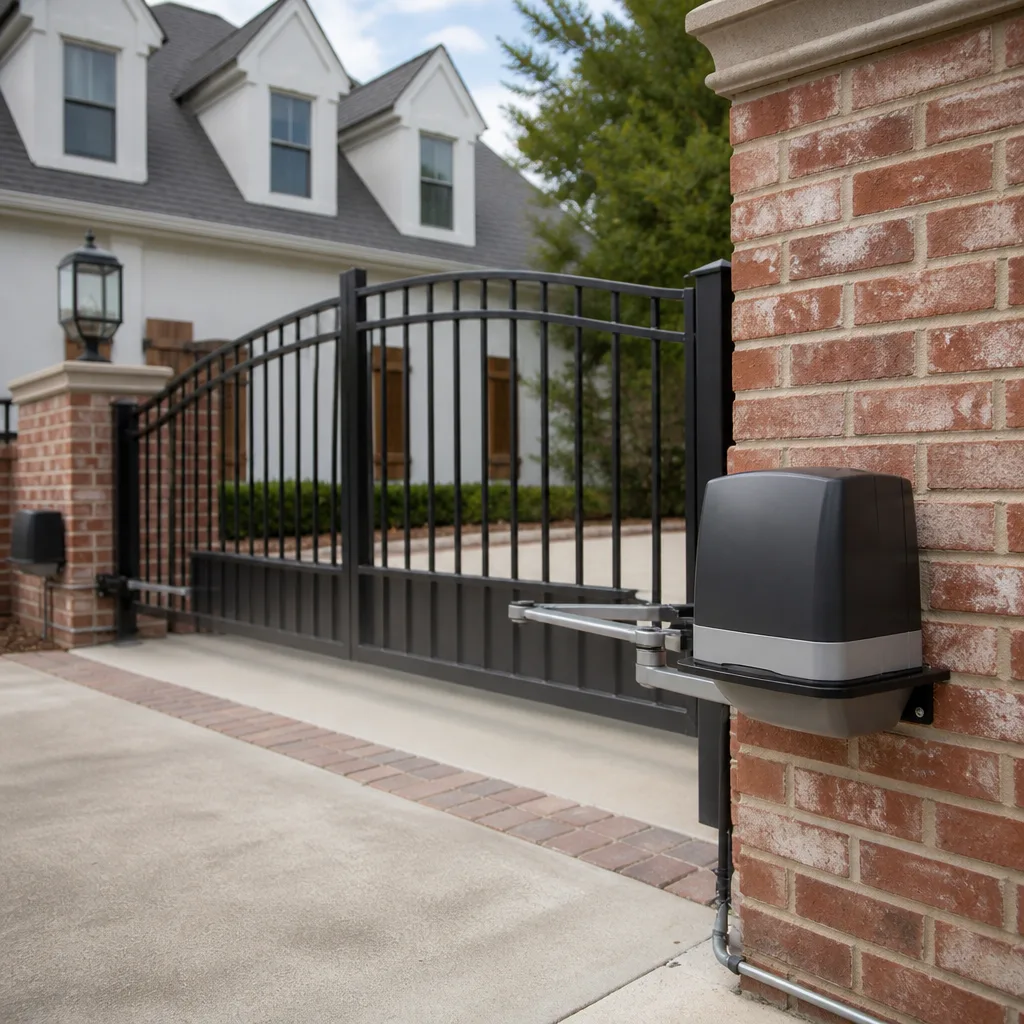 LiftMaster operators
Free on-site gate assessment - hinges, posts, and your LiftMaster or Nice gate operator checked before anything is quoted
The assessment is free and the quote is the invoice.
Get your free estimateGate Repair Emergency Preparedness Guide for Arlington Homes
Most Arlington homeowners assume their electric gate will fail the one way they’ve rehearsed in their head: stuck open, letting anyone walk up the driveway. The truth is less convenient. A dead battery backup or a tripped control board can just as easily leave the gate locked shut, trapping your car on the wrong side and turning your own driveway into a wall. The part nobody plans for is the manual release, the one piece of hardware that solves either problem in about ninety seconds, and the fact that most people have never touched it. This guide walks you through finding that release, testing your backup battery, building a one-page emergency card, and knowing exactly who to call and what to tell them when a gate in Arlington stops cooperating.
Quick Answer
To prepare an Arlington home for a gate emergency, find your operator’s manual release (it’s under the motor housing on most swing gates and on a floor-level chain or key release on slide gates), test the backup battery under load once a month, and keep a one-page card by the control panel with the release steps, the operator model, and a service number. When a gate fails, call a gate specialist with the brand and failure mode ready so the technician arrives with the right parts rather than guessing on-site.
Styles & brands we work with
- Wrought iron
- Wood & steel frame
- Farm & ranch
- Sliding driveway gates
- LiftMaster operators
Table of Contents
- Why Arlington Gates Fail When the Power Does
- How to Find and Use Your Manual Release
- Swing Gate vs. Slide Gate: Two Different Release Systems
- Battery Backup: What “Seems Fine” Actually Means
- Who to Call and What to Tell Them
- Temporary Security When the Gate Is Stuck Open
- How to Build Your Gate Emergency Card
- The Two-Minute Annual Test Plan
Why Arlington Gates Fail When the Power Does
A gate operator is a motor, a control board, a battery, and a set of safety sensors, and any one of those can take the whole system down. The failure that surprises homeowners most isn’t a mechanical break; it’s a power interruption that exposes a backup battery nobody tested. When the grid drops and the battery is weak, the operator has no reliable way to finish its cycle. Depending on the operator and the gate’s position at the moment of the outage, it can end up latched open or locked closed. Both outcomes are problems, and the second one is the one people tend to forget about because they’ve never had to live with it.
Arlington sits in a part of Northern Virginia where summer thunderstorms and the occasional winter ice event knock out power in pockets across the county, from the older homes near Ballston to the hillside properties out toward the Arlington ridge. Add the region’s freeze-and-thaw cycle through winter and early spring, and you get a second failure path: soil movement that shifts a gate post just enough to put the gate out of square, which stresses the operator every time it cycles. A gate that was aligned in October can start dragging on its track or binding on its hinges by February. An operator fighting that drag pulls harder, drains the battery faster, and gives you less warning before it quits.
The control board is the quiet third factor. Boards don’t like voltage spikes, and a nearby lightning strike or a brownout can leave a board that “works” but behaves erratically: the gate reverses mid-travel, ignores a remote, or stops short of fully closing. Those symptoms are your early warning system. If your operator was built by BFT, Linear, or any of the other major brands, the board behavior is brand-specific and predictable to a technician who works on that line regularly. That’s the case for electric gate repair before something fails outright, rather than after.
How to Find and Use Your Manual Release
The manual release is the single most important piece of gate hardware you own, and it’s the one most homeowners have never located. Every automated gate has one, by design, because operators are built to be disengaged from the gate for service or during a power loss. On a LiftMaster or Viking swing operator, the release is typically a keyed handle or a lever under the motor housing that you turn to disengage the gear. On a slide operator, it’s often a chain-and-crank mechanism reached through a small access door on the housing, or a floor-level release. The exact location depends on the brand and model, which is why step one is to actually look.
Here’s the sequence to locate and test your release without a technician:
- With the gate closed and the operator powered off at the breaker, walk the gate operator housing and find any keyed handle, lever, or access door.
- Insert the manual release key (it usually stays in the keyhole or hangs nearby; if it’s missing, that’s your first fix) and turn or pull as the housing indicates.
- Push the gate by hand. You should be able to move it freely. If it resists, the release didn’t fully engage, and you should not force it.
- Walk the gate through its full opening arc while disengaged to confirm the hinges, track, or wheels allow smooth travel.
- Re-engage the release, restore power, and cycle the gate once with the remote to confirm normal operation.
Do this once while the power is on, in daylight, with no pressure. That’s the whole point of preparedness: the first time you touch the release should not be in the dark during a storm. If the release is stiff, seized, or the key is missing, that’s a repair worth scheduling on its own.
Swing Gate vs. Slide Gate: Two Different Release Systems
Swing and slide gates fail differently and release differently, and knowing which kind you have shapes everything about your emergency plan. A swing gate pivots on hinges; its operator arm either pushes or pulls the gate leaf, and the manual release disengages that arm from the leaf. A slide gate travels along a track or hangs from a cantilever, and its operator drives a pinion along a gear rack or a chain, so its release disconnects the drive from the gate so the leaf can be rolled by hand. Getting the wrong mental model during an emergency wastes the minutes you don’t have.
Swing gate release, in short: the release is usually at the operator itself, keyed or levered, and once disengaged the gate swings freely by hand. Watch for the gate to drift on a slope; a disengaged swing gate on a driveway grades toward the street can roll on you.
Slide gate release, in short: the release typically frees the drive gear, after which you roll the gate along its track by hand. On a heavy slide gate, this is a two-person job. If the gate has come off its track or the wheels are damaged, do not try to force it; a heavy panel that drops can crush a hand or worse.
One safety note that applies to both: an automated gate carries real force in the operator’s wiring and crushing weight in the gate leaf itself. We’ve seen too many homeowners try to muscle a bound gate free and hurt themselves in the process. If the release won’t move or the gate won’t roll, treat that as a job for a trained technician, not a project for a Saturday. A stuck gate is inconvenient; a dropped gate leaf or a shock from operator wiring is a different category of problem entirely.
Battery Backup: What “Seems Fine” Actually Means
A backup battery that “seems fine” during normal operation is often the weak link in a gate emergency, because normal operation gives the battery almost no workout. The battery only proves itself when the grid goes down, and by then it’s too late to test it. The failure pattern is consistent and boring: a battery in its final months will power one or two cycles on a power loss, then sag, leaving the gate stranded wherever the cycle ended. If that’s mid-travel with the gate latched, you’re locked in or locked out.
What adequate backup capacity actually looks like depends on the operator and the gate’s weight and travel distance. A light residential swing gate on a LiftMaster or Ghost Controls operator needs less reserve than a long, heavy slide gate on a commercial-grade FAAC or DoorKing system. The useful question isn’t just “does the battery hold a charge” but “will it carry this specific gate through a full open-and-close cycle plus a couple more on a cold morning.” A battery that passes a static voltage check can still fail under load.
Here’s how to test it before an outage:
- Find the battery in the operator housing (consult the model’s documentation for location; on most brands it’s a sealed unit with two terminals).
- With the gate closed, cut power at the breaker and command a full cycle using the remote.
- Watch whether the gate completes open and close cleanly, at close to normal speed. A sluggish or partial cycle means the battery is near the end of its life.
- Restore power and note the result. If the cycle was slow or incomplete, replace the battery rather than waiting for it to fail.
- Repeat the test monthly, and always before storm season.
Battery life varies by ambient temperature, cycle count, and operator brand. In our experience, a backup battery that’s reached the end of its usable life behaves the same on every brand: fine until the moment it matters.
Who to Call and What to Tell Them
The difference between a gate fixed the same day and a gate fixed after two extra visits often comes down to what you tell the dispatcher. A gate specialist who knows your operator brand and failure mode can load the right parts and arrive ready. A generalist or a multi-trade shop will often arrive without the specific control board, battery, or safety sensor your system needs, then come back when the part is sourced. We’ve built our whole approach around avoiding that second trip. Our technicians have up to 10 years of experience, and we’ve worked across nine operator brands, from residential-grade Ghost Controls and Mighty Mule to commercial systems from FAAC, BFT, and DoorKing.
When you call, have these four things ready:
- Gate brand and operator model. The nameplate is on the operator housing. If you only know the brand, say so; a photo helps.
- Failure mode. Is it stuck open, stuck closed, reversing, ignoring the remote, or making a new noise? “Stuck closed, no response to remote” tells us more than “it’s broken.”
- Power status. Is the grid up or down? Did you already test the manual release? Did the gate fail with the power on?
- Access constraints. Is the gate blocking a driveway you can’t vacate, a shared HOA entry, or a commercial lot? Does the property have a second access point?
Call (855) 349-3550 with those details and get a free estimate. A specialist who’s worked your brand before will diagnose on the first visit rather than the second. For a full rundown of what we cover, see our gate repair page. If your gate is automated and the failure is electrical, the electric gate repair page walks through the motor, board, and sensor side of the system.
Temporary Security When the Gate Is Stuck Open
A gate stuck open during a power failure or a failed operator is a security gap you have to close another way until a technician arrives. The good news is that the most effective options are the ones you can set up in fifteen minutes with things you already own, and the least effective are the ones that feel reassuring but don’t actually stop anyone. A gate that stays open at a residential driveway is a door left ajar; how you handle the gap matters more than how the gate looks.
What works: a physical barrier at the actual secure point. If the gate protects your vehicles, park a car across the opening if you can spare it, or set out a temporary barricade or a couple of heavy planters. A motion-activated light aimed at the opening makes the gap visible to anyone on the property and to neighbors, which is often enough. Close and lock the garage or entry door the gate was protecting. Tell a neighbor the gate is open and why, so they can flag anything odd.
What doesn’t work: a bungee cord, a chain across the opening, or a padlock meant to “hold” the gate in the closed position. These create a trip or crush hazard and can damage the operator or gate when the motor does engage again. They also give a false sense of security: a bungee cord across a driveway stops nobody. And never wedge the gate leaf itself; a heavy panel that shifts can fall.
For a commercial property or HOA entry, the temporary fix is often just making sure the property manager knows and that a secondary barrier (a second door, interior gate, or lobby access) is the real lock until the gate is repaired. The best gate emergency plan includes a secondary access path so the property isn’t fully dependent on one gate.
How to Build Your Gate Emergency Card
A gate emergency card is a single physical sheet, laminated or in a clear sleeve, kept inside or beside the operator housing, that lets any member of the household handle a gate failure without calling anyone first. It’s the cheapest piece of gate preparedness you can build, and it’s the one most people skip. The card turns a stressful middle-of-the-night failure into a set of steps anyone can follow.
Build it with these fields:
- Gate type: swing or slide, and which side.
- Operator brand and model, copied directly off the nameplate (for example, the LiftMaster, Viking, or Linear model on your unit).
- Manual release instructions, written in plain language, with a small diagram of where the keyed handle or access door is. Take a photo of the release location and tape it to the card.
- Power location, meaning where to cut power to the operator at the breaker, and the breaker label.
- Battery test steps, the short version of the load test above.
- The service line number. Write (855) 349-3550 on the card in large print; this is the number you want to find fast.
- Who to notify: for an HOA property, the board contact; for a business, the manager; for a shared driveway, the neighbors.
Keep a second copy inside the house near the garage entry or the kitchen, so the person who’s first on the scene doesn’t have to walk to the control panel in the dark. Update the card whenever you replace the operator or move the breaker.
The Two-Minute Annual Test Plan
The whole reason a gate emergency feels like an emergency is that the failure is unannounced. A short, repeatable test each year converts most of those surprises into routine maintenance. The test is genuinely two minutes of physical work if you know where everything is, and it exercises the exact components that fail when they fail.
Here’s the sequence:
- Examine the gate and operator visually: check hinges, track, wheels, and any obvious damage.
- Test the safety sensors by breaking the beam while the gate is closing; the gate should reverse.
- Disengage the manual release, walk the gate through a full cycle by hand, and re-engage it.
- Run the battery load test from the section above by cutting power at the breaker.
- Test the remote and any keypad or access hardware from outside the gate.
- Update the emergency card if anything changed.
Do this before storm season and before winter, when cold weather puts the most stress on the operator. If any step reveals a problem, that’s the moment to schedule a repair rather than a replacement emergency. A gate that’s tested in daylight is a gate that fails gracefully. When a big system is heading toward the end of its life, new installation is often the cleaner path, and we handle both Arlington repair and full replacement under one specialty.
Common Mistakes to Avoid
- Skipping the manual release test because the power is on. The release is the one thing you need when the power is off, which is the worst time to learn how it works. Test it now, in daylight, with the breaker off.
- Assuming a green or “good” battery is a working battery. Static voltage checks pass on batteries that fail under load. Test the battery by cutting power and running a real cycle, not by looking at a status light.
- Calling a general contractor first. A multi-trade shop will often diagnose the gate as a “door problem” and arrive without your brand’s board, battery, or sensor. Call a gate specialist who knows your operator.
- Wrapping a bungee cord or chain across the opening when the gate is stuck open. It doesn’t secure the property and it can damage the operator when the motor re-engages. Use a physical barrier at the actual entry door instead.
- Ignoring a gate that’s out of square after winter. Soil movement from freeze-and-thaw is common in Arlington, and a gate that drags is stressing its operator every cycle. Fix the alignment before the operator fails.
- Forgetting to write down the operator brand and model. It’s on the nameplate, and it’s the first thing a dispatcher will ask for. Put it on the emergency card before you need it.
- Letting the key for the manual release go missing. A release you can’t open is a release you don’t have. Keep the key in or near the operator housing and note its location on the card.
See the difference
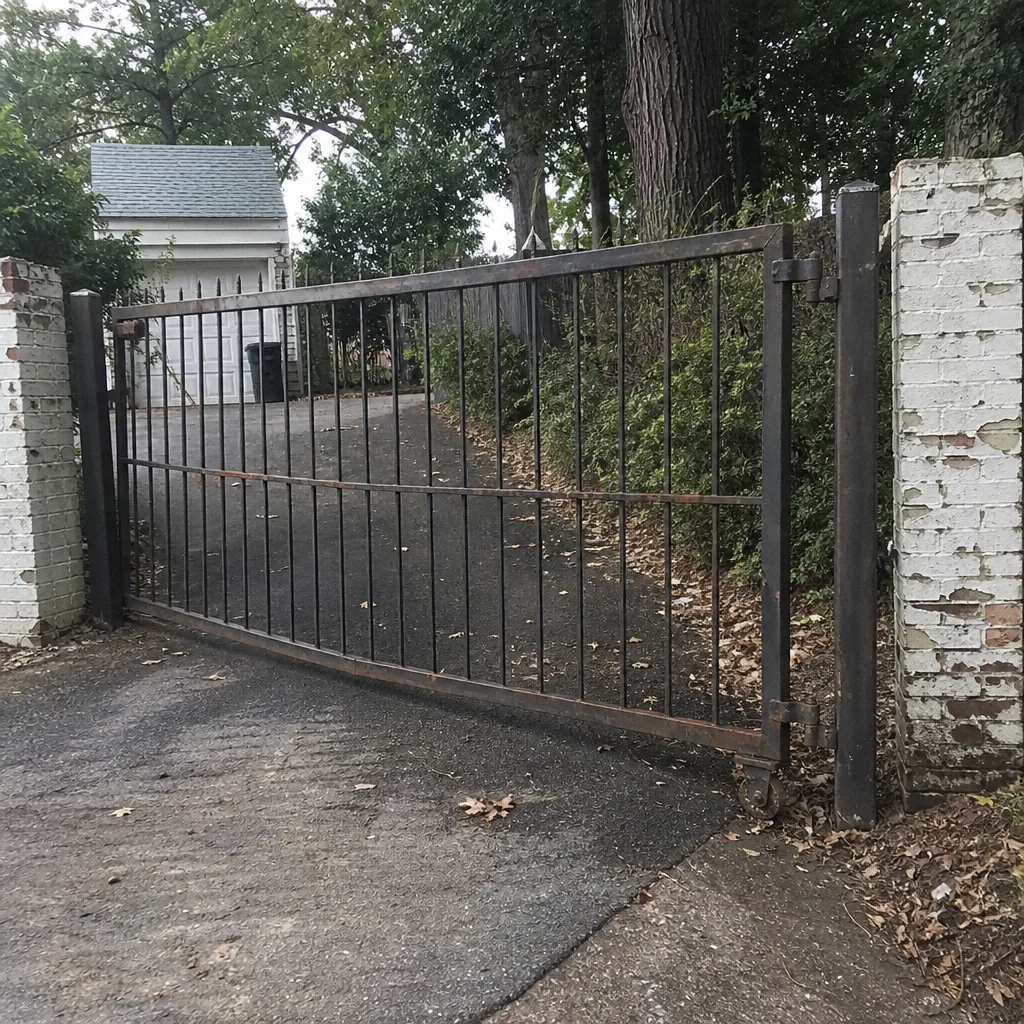
 Before
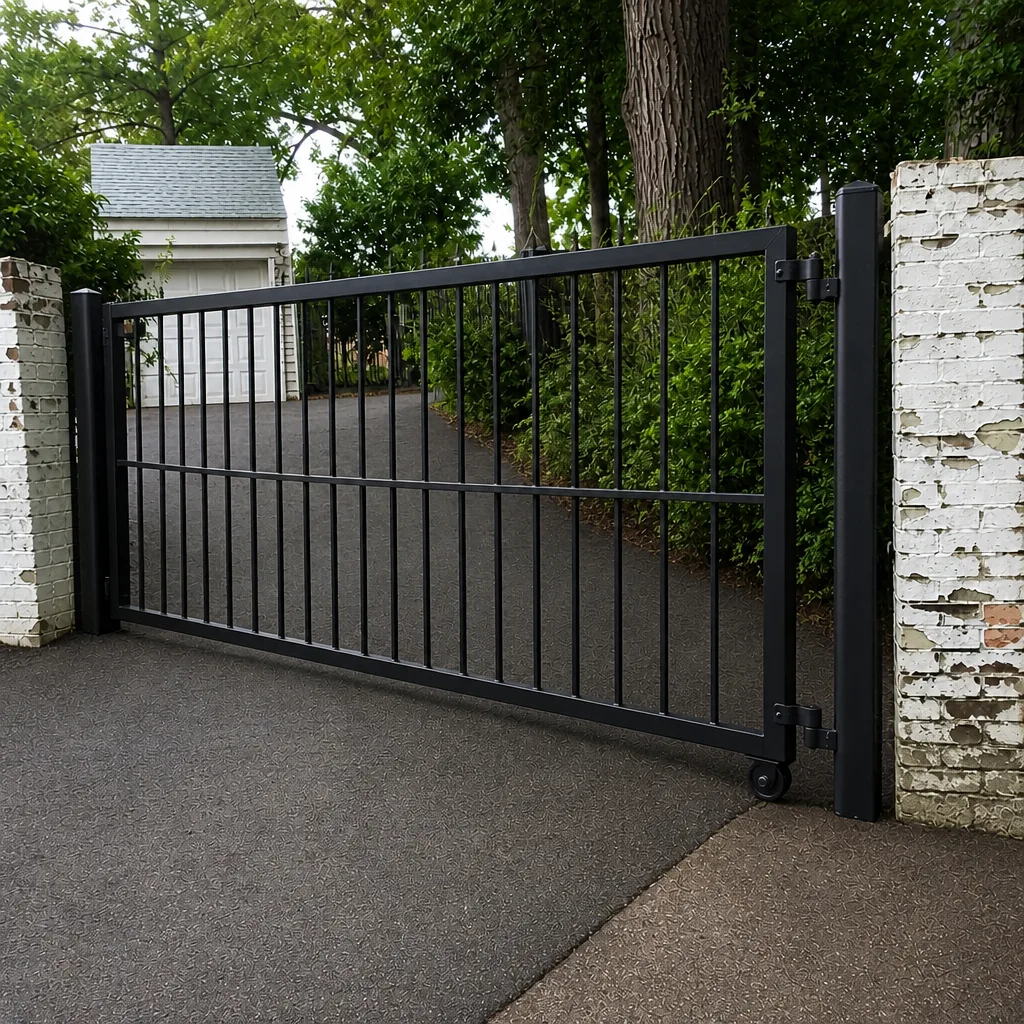
 After
 Before
 After
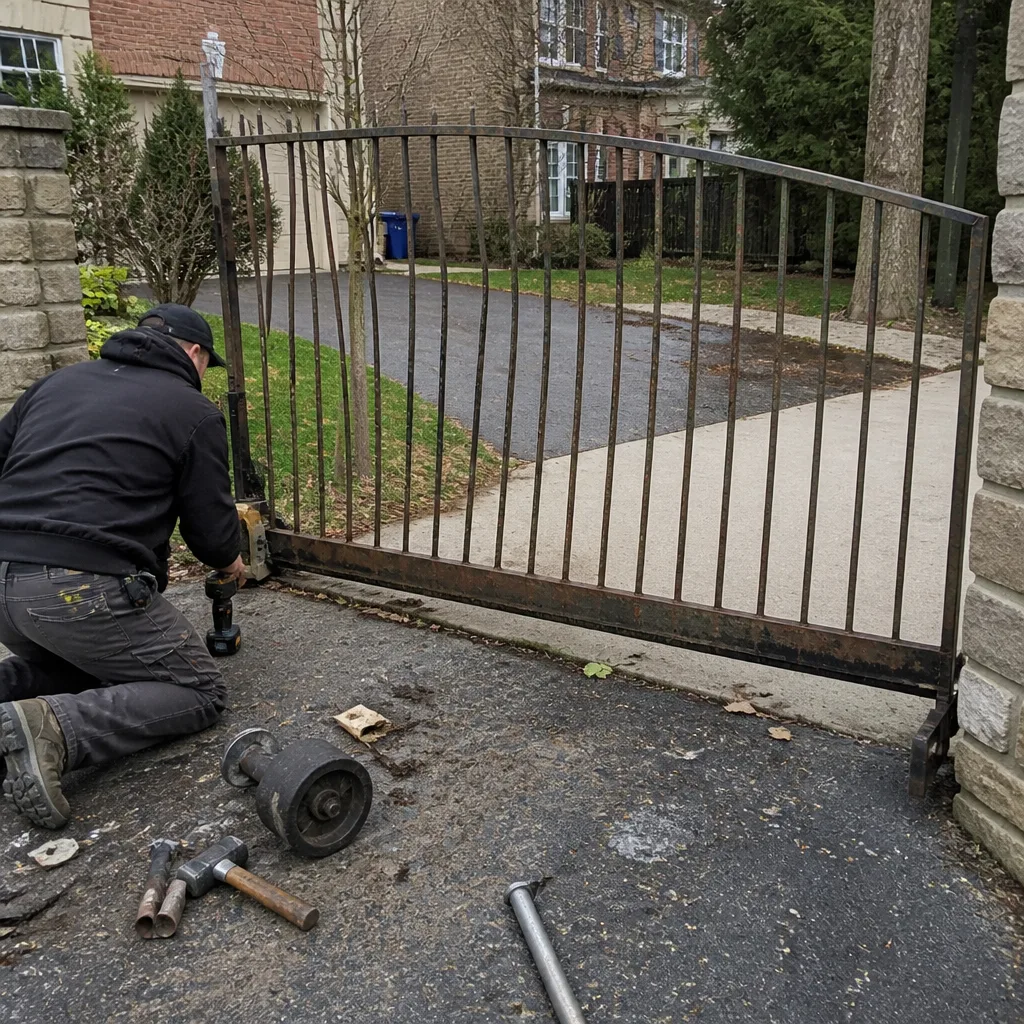 Before
 After
When to Call a Professional
Call a gate specialist when the manual release won’t move or the gate won’t roll by hand, when the operator ignores the remote or reverses erratically, when the battery fails a load test, or when the gate is dragging on its track or hinges after a winter of freeze-and-thaw. Call immediately if the gate is blocking an access you can’t vacate, if a gate leaf has come off its track or is in danger of falling, or if there’s any question about the operator’s power wiring. Gate operators carry real force in their electrical components and real weight in the panels, so a bound or misaligned gate is a job for a trained technician, not a weekend project. Arlington Gate Service offers free estimates in Arlington. Call (855) 349-3550. We answer 24/7. Fast dispatch, 7am-7pm, Sunday through Friday.
Frequently Asked Questions
The manual release is usually on the operator housing: a keyed handle or lever under the motor cover on most swing gates, and a chain-and-crank or floor-level release on most slide gates. The exact location depends on the brand and model, so check your operator’s nameplate and documentation. On brands like LiftMaster and Viking, the release is keyed and stays in the housing; on slide operators, it’s often reached through a small access door. If the release is missing or seized, that’s the first thing to repair before an emergency. Call (855) 349-3550 for a free estimate. Estimates are free.
Use the manual release to disengage the operator and move the gate by hand, then secure the opening. If the release won’t engage or the gate won’t move, don’t force it; a bound gate can injure you or damage the operator. Call (855) 349-3550 and tell the dispatcher your gate brand, operator model, and whether the grid is up or down. We answer 24/7. Fast dispatch, 7am-7pm, Sunday through Friday. A call outside dispatch hours is booked into the next opening.
Test it under load, not at rest. With the gate closed, cut power at the breaker and run a full open-and-close cycle using the remote; if the gate is slow, stops short, or doesn’t complete the cycle, the battery is failing and should be replaced. A green light or a static voltage reading can pass on a battery near end of life. Test monthly and before storm season. Call (855) 349-3550 for a free estimate if the load test fails.
Have four things ready: the gate brand and operator model from the nameplate, the failure mode (stuck open, stuck closed, reversing, unresponsive), whether power is up or down, and any access constraints like a blocked driveway or shared HOA entry. That tells a specialist enough to load the right parts and diagnose on the first visit rather than the second. If you’re not sure of the brand, a photo of the nameplate helps. Call (855) 349-3550. Estimates are free.
Yes, temporarily, by securing the actual entry point the gate protects rather than the gate itself. Park a car across the opening if you can, set out a heavy barricade or planters, aim a motion light at the gap, and lock the garage or entry door the gate was protecting. Don’t chain or bungee the gate leaf, which creates a hazard and can damage the operator. For an HOA or commercial property, notify the property manager. Call (855) 349-3550 to schedule the repair.
Repair is usually the right call when the issue is a single component like a battery, sensor, or control board; replace when the operator is at the end of its life, the gate itself is out of square or damaged, or repairs are recurring. An on-site diagnosis settles it. We handle both repair and full installation under one specialty, so you’re not sourcing a second contractor if replacement is the answer. Call (855) 349-3550 for a free estimate. Estimates are free.
The Bottom Line
An Arlington gate emergency is almost always a predictable failure you could have rehearsed. The manual release exists on every automated gate, and the first time you touch it should be in daylight, before you need it. Test your backup battery under load, not by looking at a light. Write a one-page emergency card with the release steps, the operator model, and the service number, and keep copies in the house and at the panel. Know what to tell a dispatcher: brand, model, failure mode, power status, and access constraints. Do all of that, and a gate failure becomes an interruption instead of an emergency.
If your gate is stuck, failing, or overdue for a test, or if you’re ready to talk through repair or replacement, call (855) 349-3550 for a free estimate. We answer 24/7. Fast dispatch, 7am-7pm, Sunday through Friday. Wherever you are in the county, Arlington Gate Service is a gate-only specialist that knows your brand and gets it diagnosed right the first time.
Written by the team at Arlington Gate Service.