
Last updated November 15, 2026
 Wrought iron
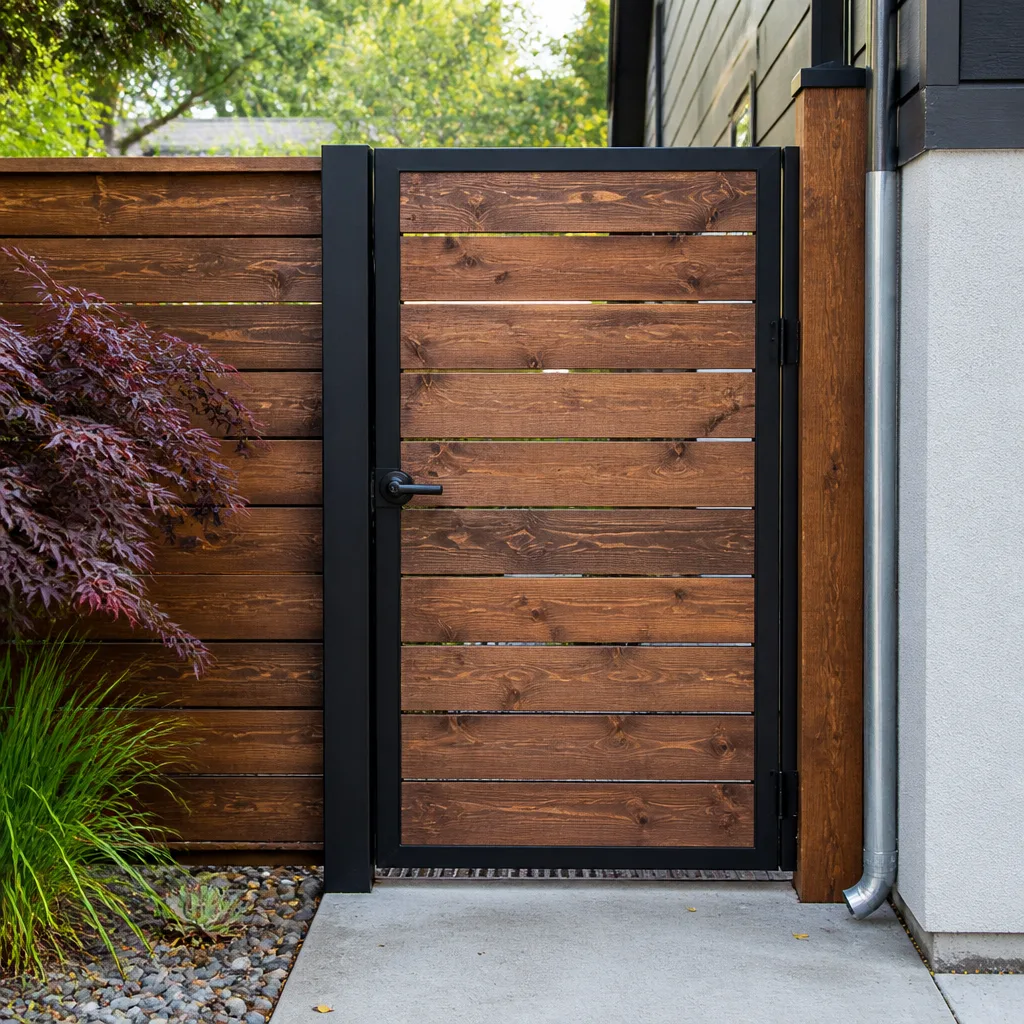 Wood & steel frame
 Farm & ranch
 Sliding driveway gates
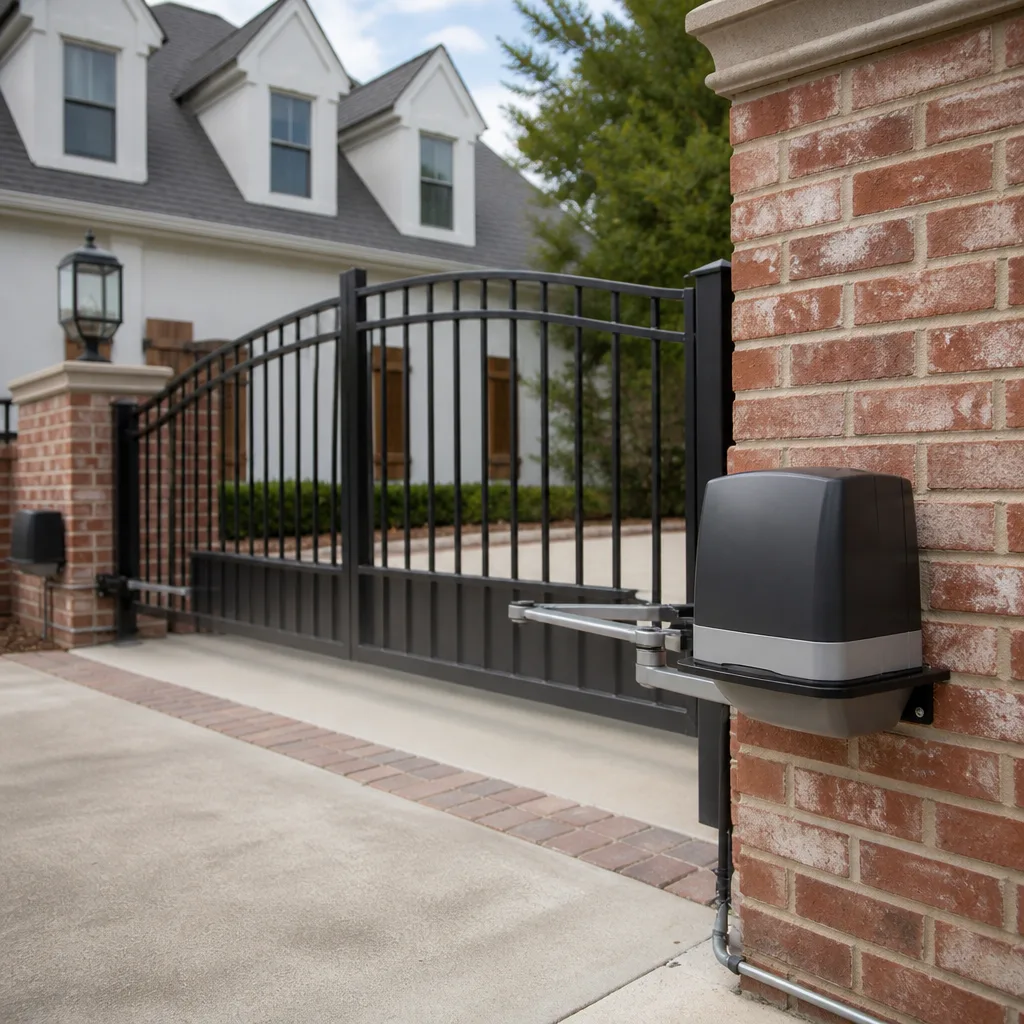 LiftMaster operators
Free on-site gate assessment - hinges, posts, and your LiftMaster or Nice gate operator checked before anything is quoted
The assessment is free and the quote is the invoice.
Get your free estimateGate Repair Maintenance Checklist for Arlington Homeowners
Lubricating a LiftMaster operator the same way you’d lubricate a FAAC or an Elite is one of the most common DIY mistakes we see around Arlington. Wrong lubricant, wrong interval, wrong points. The checklist most homeowners follow was written for no gate in particular, so it treats a light residential arm operator and a heavy commercial slide gate as if they need the same care. They don’t. This guide is built around the systems actually installed on Arlington driveways and property entrances, with brand-specific notes, a post-winter routine for Northern Virginia’s freeze-thaw cycle, and the sensor tests most checklists skip entirely. You’ll learn what to handle yourself, what to outsource, and what to write down so the next repair is faster and cheaper.
Quick Answer
A solid gate maintenance routine for an Arlington home means a visual inspection and hardware check every month, a lubrication and sensor pass every quarter, and a full operator, hinge, and post review once a year. Electric gates need a monthly safety-reversal and obstruction test on top of that, done by hand, every time. The single most valuable habit is keeping a written record of each inspection: the brand and model of your operator, what you checked, and what changed.
Styles & brands we work with
- Wrought iron
- Wood & steel frame
- Farm & ranch
- Sliding driveway gates
- LiftMaster operators
Table of Contents
- How Gates Fail in Arlington’s Climate
- Your Monthly Ten-Minute Inspection
- The Quarterly Lubrication Pass, by Brand
- The Post-Winter Checklist for Freeze-Thaw Damage
- Testing Safety Reversal and Obstruction Sensors
- The Annual Deep Review
- What to Document at Every Inspection
- Common Mistakes to Avoid
How Gates Fail in Arlington’s Climate
Arlington sits in a climate with real winter swings and humid summers, and both show up in gate hardware long before a gate actually stops working. The freeze-thaw cycle is the big one. Water works into hinge gaps, into the seams at post footings, and into the small clearances around operator brackets. When it freezes, it expands. When it thaws, it leaves a slightly wider gap. Repeat that through a Northern Virginia winter and you get hinge pins that move, brackets that loosen a quarter turn, and gates that no longer sit square in the opening. None of that is dramatic. It’s cumulative, and it’s the reason a gate that worked perfectly in October can drag on the ground by March.
Summer heat is the quieter problem. Control boards on electric gates live inside a housing that heats up in direct afternoon sun, and moisture that collected in the enclosure during wet spring weather becomes condensation when temperatures swing. That condensation is one of the most common reasons a control board fails without any obvious cause. Heavy use during the busy months also accelerates wear on a drive gear or motor that was already near the end of its service life.
Grade matters too. Arlington’s neighborhoods run from flat riverbottom parcels to sloped driveways where water drains toward the gate rather than away from it. If your driveway is one of the sloped ones, your checklist should include a look at drainage at every inspection, not once a spring cleanup.
We work on your brand, which means we see the same failure patterns across specific operator families. Residential electric gate repair calls on a LiftMaster swing operator usually trace to battery, gear, or sensor issues. Heavy commercial slide gates with DoorKing or FAAC operators tend to fail at the control logic level first. The checklist below accounts for the difference.
Your Monthly Ten-Minute Inspection
This is a visual and tactile walk-around, not a repair session. Ten minutes, no tools beyond a flashlight, and it catches most developing problems before they become a service call. Do it from a standing position with the gate closed, then again as you manually walk the gate through its swing or slide.
- Walk the full length of the gate and watch for sag. Look at the gap between the bottom of the gate and the ground at both ends. If one end sits noticeably lower, your hinge, post, or gate frame has moved.
- Check the hinges and hinge pins for looseness and rust. A hinge pin that rotates freely in its bracket by hand is already past its adjustment.
- Look at the post base for cracks in the concrete, visible lean, or soil pushed away at the bottom. Any movement here is a structural issue and should not wait.
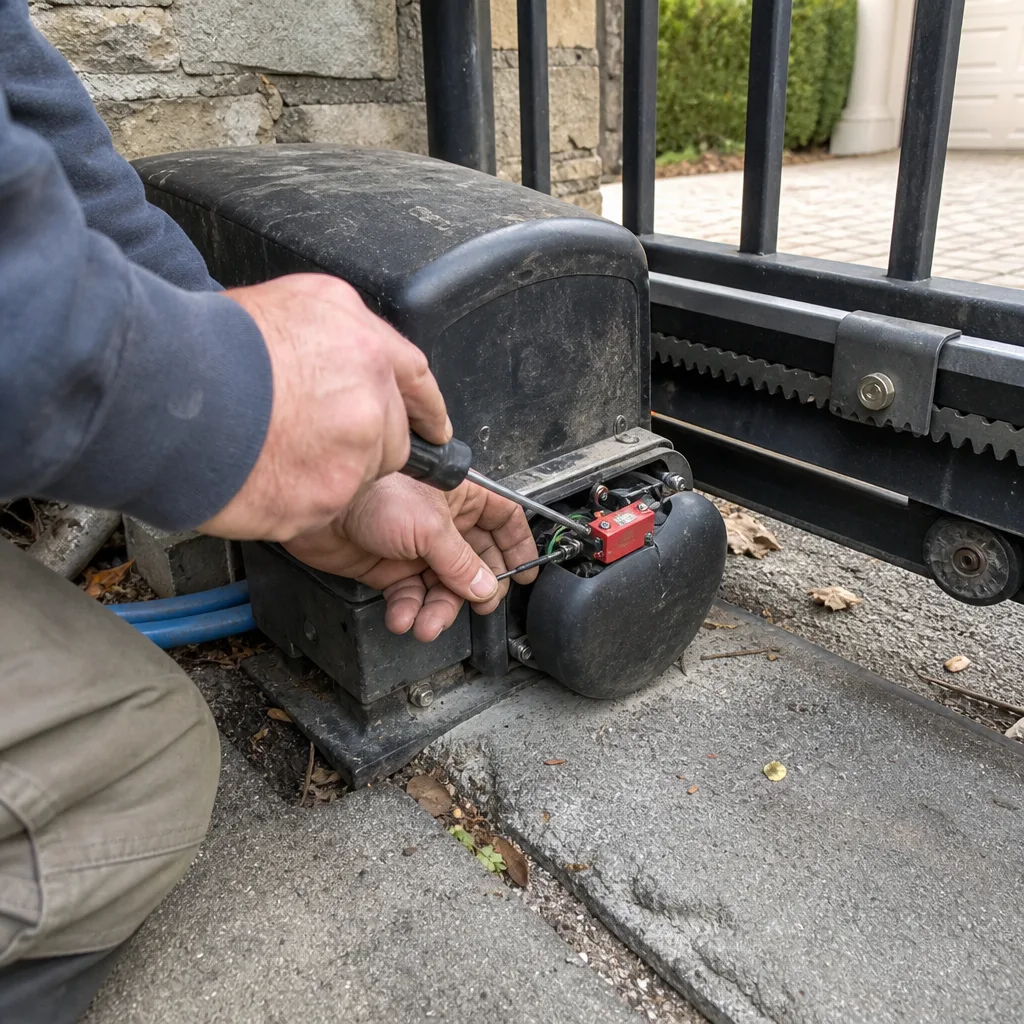
- Listen to the operator through one full open and close cycle. Grinding, clicking, or a motor that stalls and starts are all early warnings.
- Check the drive track and rollers on slide gates for debris: leaves, twigs, mulch, and gravel from a nearby driveway all accumulate and cause drag.
- Inspect the safety edges and sensors for visible damage, dirt, or obstruction. A dirty photo-eye is a false-triggering gate waiting to happen.
- Look at the control enclosure for moisture, insects, or a lid that isn’t fully sealed. On humid Arlington afternoons, that enclosure is where early problems live.
Write the date and anything you noticed in a notebook or on the inside of the control enclosure lid. Ten minutes a month buys you a much more predictable gate.
The Quarterly Lubrication Pass, by Brand
Lubrication is where brand matters most, and where a generic checklist does real damage. The wrong lubricant on the wrong mechanism attracts grit, gums up over time, or attacks seals. Here’s how to think about it by operator family, not by the one-size-fits-all advice you see online.
LiftMaster (and other residential arm operators)
Arm-style residential operators are exposed to weather and use lighter-duty mechanical parts. The arm joints and the pivot points at both ends of the arm are what need attention. Light grease or a manufacturer-specified lubricant on the pivot pins is right; heavy grease on the arm itself will collect grit. Avoid spraying lubricant anywhere near the motor housing vents or the manual-release mechanism, which needs to stay dry and grippy.
FAAC (and other commercial-grade slide operator drives)
FAAC slide operators typically rely on a drive gear and a rack or chain, and that drive interface wants a different treatment than an arm operator. Chain drives need chain-applicable lubricant at a realistic interval, and rack-and-pinion drives need clean gear surfaces. Avoid greasing the rack heavily in Arlington’s spring pollen season; pollen sticks to grease and grinds through the mesh. Clean first, then lubricate lightly. Never spray lubricant into a control box or onto the motor terminals.
Viking and other hydraulic or heavy-duty operators
Hydraulic operators don’t want the same lubricant on the piston as on the linkage, and hydraulic fluid levels are a separate check best left to a specialist. The pivot joints and any greasable bearings benefit from a proper grease gun pass. Avoid automotive spray lubricants on hydraulic fittings. Viking hardware holds up well but quietly wears at the pivot points if it’s never serviced.
Mighty Mule and other residential kits
Light residential operators need the least lubrication but benefit most from a clean, dry installation. Keep the arm clean, keep the pivot points lightly lubricated, and keep the control housing sealed. On these operators, less is more.
In our experience, the single most important brand-specific rule is this: clean before you lubricate. A dry, clean mechanism with the right lubricant in the right place outlasts a greasy one every time.
The Post-Winter Checklist for Freeze-Thaw Damage
March and April are the months Arlington gates tell the truth. Whatever moved over the winter shows up once the ground thaws and the gate goes through its first full open-and-close cycle in warmer temperatures. Run this checklist once, fully, every spring. It takes 30 to 45 minutes and catches the damage that would otherwise show up as a mid-July repair.
- Open and close the gate slowly by hand with the operator disengaged, and listen. A gate that binds in one spot or drags at the bottom is telling you the hinge, the post, or the frame has shifted over winter.
- Measure the hinge gaps at every hinge. Compare the top and bottom gaps. A visible difference means a hinge is worn or a weld has let go. Hinge gap changes are the most reliable early warning of frame movement.
- Check the post for movement. Push firmly against the post with the gate open and look for rocking at ground level. Even a small post movement will eventually bind the gate.
- Inspect the control board and enclosure for moisture. Look for water stains, corrosion on terminals, or a fogged lens. Moisture that got in during the winter is doing damage now, not in six months.
- Test the limit switches by running the gate fully open and fully closed. If the operator stops short, over-travels, or reverses at the end of travel, the limits need adjustment.
- Test the safety reversal and obstruction sensing (see the dedicated section below). Post-winter is the highest-risk time for a sensor that was working in the fall.
- Check drainage at the gate footing. If water is pooling at the base, fix it now. Water pooling is what accelerates footing movement in the next freeze-thaw cycle.
If you find post movement, hinge gap changes, or moisture in the control board, stop the checks and book a diagnostic. Those are three of the four conditions we most often see turn an inexpensive repair into a system replacement.
Testing Safety Reversal and Obstruction Sensors
Safety reversal and obstruction sensing is the part of gate maintenance most checklists omit entirely, and it’s the part that actually matters. On an automated gate in Arlington, the sensors that stop or reverse the gate when something is in its path are a code and liability issue, not just a convenience feature. A gate that closes on a person, a pet, or a vehicle causes real injury and real damage, and it may not show any symptom until the day it matters. Test these sensors monthly, and any time you’ve had a technician out.
- Photo-eye test: with the gate in its opening cycle, break the beam between the two photo-eyes with your hand or an object. The gate should stop or reverse. Repeat on the closing cycle.
- Obstruction test (closing cycle): place a firm object, not your body, in the closing path. The gate should reverse when it contacts the object. Repeat at two points in the closing arc.
- Safety edge test: on gates with a pressure-activated edge, press the edge firmly and confirm the gate reverses.
- Manual override test: disengage the operator and manually move the gate through its full travel. If it binds, note where.
- Sensor alignment check: wipe the lens on each photo-eye and confirm the gate accepts the beam cleanly. On a humid Arlington morning, dirty or misaligned lenses are the cause of most false triggering.
Never test a safety reversal by standing in the path of the gate. The test is meaningful only when the sensor is working. Use an object and stand clear.
If the gate passes all five of those tests, you have done a real safety inspection. If it fails any of them, unplug or otherwise disable the automation and get a specialist out before using the gate again.
The Annual Deep Review
Once a year, hand the gate a full afternoon or bring in a specialist. This is the check that surfaces the problems monthly and quarterly inspections can’t: motor and gear wear, control board health, drive alignment, post integrity, and hinge replacement. It’s also the inspection that keeps a gate working for 15-plus years instead of 8.
What a solid annual review covers:
- Motor and gear inspection inside the operator housing. Gear teeth wear, motor brushes wear, and hydraulic units may need fluid checks.
- Control board inspection for corrosion, failed capacitors, and burned traces. This is where brand-specific familiarity saves time.
- Drive alignment on slide gates: chain tension, rack mesh, and operator alignment to the gate.
- Hinge and roller replacement as needed. Worn hinges are cheap to replace and expensive to ignore.
- Post and footing review for movement, cracks, and drainage.
- Full lubrication pass as described above, by brand.
- Safety sensor and safety edge replacement where age or damage suggests the sensor is on its way out.
This is also the right time for a full gate repair review if the gate has any chronic issues: a gate that reverses spontaneously, a gate that stops halfway, or a gate that needs a manual push to complete a cycle. Those symptoms are telling you something specific, and the annual review is the right moment to find out what.
If the annual review turns up a system that’s past economical repair, we also handle full installation, so you don’t have to source a second vendor. Our gate specialist team diagnoses the actual brand on-site and works from there, rather than applying a one-size-fits-all approach.
What to Document at Every Inspection
A maintenance record is the single most useful document for a gate, and almost nobody keeps one. When something fails, the record saves hours of diagnostic time. When a warranty claim comes up, the record is what proves you serviced the system as intended. When a new technician shows up, the record tells them exactly which brand and model they’re working on, which is half the diagnostic work.
Here’s what to write down, every inspection, in a notebook or a shared note on your phone:
- Date and time of the inspection. Trivial but critical for warranty claims.
- Operator brand and model. Take a photo of the nameplate on the operator housing and the control board. LiftMaster, FAAC, Viking, DoorKing, Elite, and Linear all have different control architectures, and the technician needs the exact model.
- Cycle count if your operator reports it. Many do. The cycle count is the honest measure of wear.
- Anything you noticed. “Heard a click during closing” or “hinge #2 looks loose” is real diagnostic data.
- What you did. Lubricated, adjusted, replaced, cleaned. Keep it specific.
- Photos. One of each hinge, the post base, the control board, and the full gate in the closed position. Date-stamped if possible.
Keep the record with the gate’s manual and warranty paperwork. When we work on an Arlington gate, a record like that turns a 90-minute diagnostic into a 30-minute one.
Common Mistakes to Avoid
- Using the same lubricant on every brand. A spray can of automotive lubricant is the wrong treatment for a LiftMaster arm pivot and the wrong treatment for a FAAC drive gear. Wrong lubricant attracts grit, gums up, and accelerates wear. Match the lubricant to the mechanism.
- Skipping the safety reversal test. It’s the most common omitted step on every checklist we’ve reviewed, and it’s the one that matters most. A gate that fails to reverse is a liability. Test it monthly, and use an object, never your body.
- Ignoring small hinge gap changes. Arlington’s freeze-thaw cycle widens hinge gaps a little every winter. Left alone for two or three seasons, small gaps become a frame that binds or a hinge that fails.
- Lubricating without cleaning first. A greased-over dirty hinge is still dirty. Clean first, then lubricate lightly.
- Letting the control enclosure seal degrade. A cheap seal that lets moisture in during a wet Arlington spring can cost you a control board. Check the seal at every inspection, and replace it when it hardens.
- Not recording the operator brand and model. A technician arrives, and nobody knows if the operator is a LiftMaster or a Linear. That’s 30-plus minutes of diagnostic time and a delay on parts.
- Attempting operator internals yourself. See the safety note below. The parts inside a gate operator involve mains electrical connections. That’s a specialist’s work.
A safety note we’d give any Arlington homeowner: the dangerous parts of a gate are the operator’s wiring and power, the weight of a heavy panel that can crush if it falls, and a slide gate that can come off its track. None of those are DIY territory. Have a licensed specialist handle any inspection that involves opening the operator housing or working near mains wiring.
See the difference
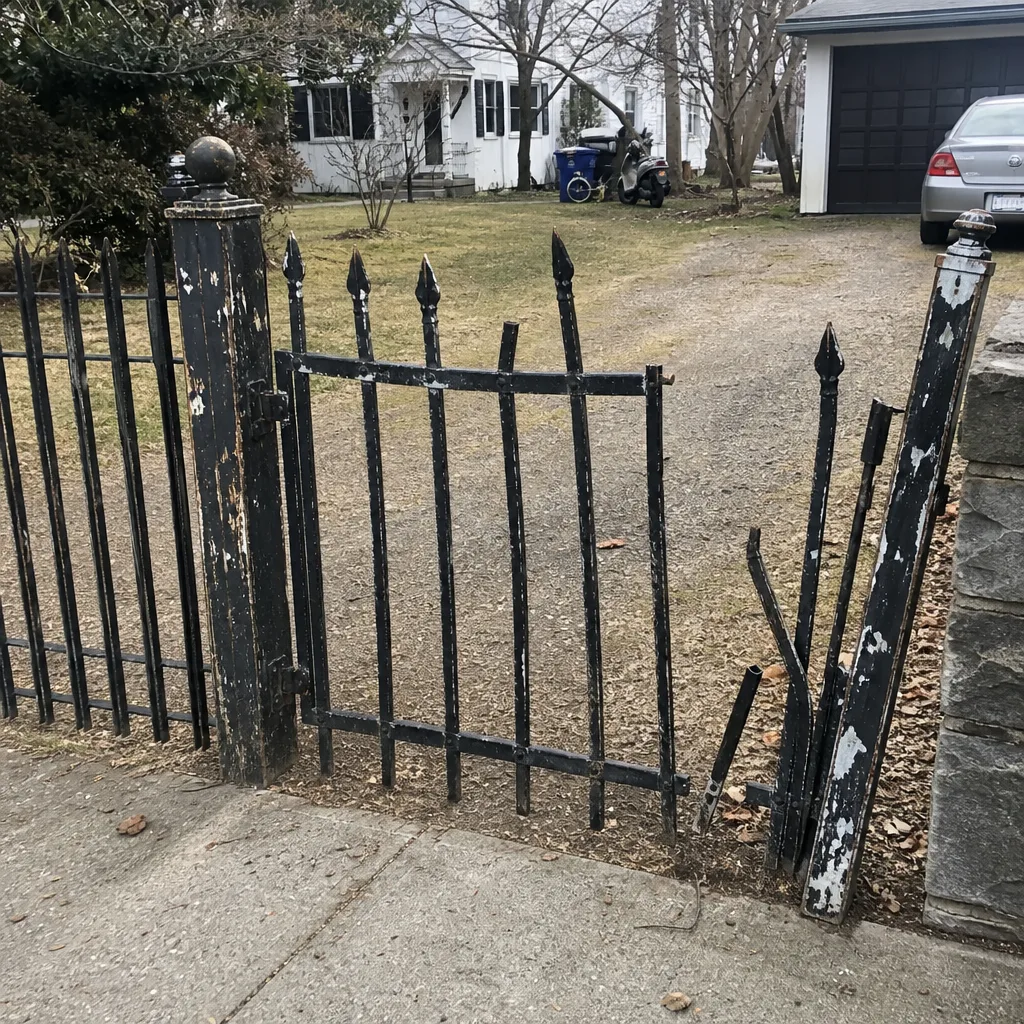 Before
 After
 Before
 After
 Before
 After
When to Call a Professional
Some things you can handle yourself, and some things you can’t. Handle the monthly inspection, the visible cleaning, and the record-keeping. Bring in a specialist when you find any of the following: post movement or a cracked concrete footing, a hinge or frame that’s visibly bent, moisture or corrosion inside the control board, an operator that runs through its cycle but stops, reverses, or stalls unexpectedly, a safety sensor that fails any of the reversal tests, or a gate that binds when moved manually. Those are all signs of a real fault that won’t resolve with more lubricant, and on an automated gate, they’re a safety concern. Our technicians have up to 10 years of experience and work on your specific brand, which is what gets the diagnosis right the first time. Arlington Gate Service offers free estimates in Arlington – call (855) 349-3550. We answer 24/7. Fast dispatch from 7am to 7pm, Sunday through Friday.
Frequently Asked Questions
Most residential operators need lubrication every three months, with a light clean-and-lubricate every spring. The right interval depends on brand and use: a LiftMaster arm operator on a residential driveway is usually fine at the quarterly cadence, while a commercial-grade FAAC slide operator on an HOA entrance may need more frequent attention to its chain or rack. Clean before lubricating every time. If you’re not sure which lubricant suits your specific operator, call (855) 349-3550 for an exact recommendation – estimates are free.
Test the photo-eye safety beam and the obstruction reversal every single month. Break the beam during the closing cycle and confirm the gate reverses. Place a firm object (never your body) in the closing path and confirm the gate reverses on contact. Wipe the photo-eye lenses and confirm clean alignment. If any test fails, stop using the automation and book a diagnostic – call (855) 349-3550 for an exact quote, estimates are free.
Freeze-thaw movement. Water works into hinge gaps and post footings during wet winter weather, then expands when it freezes and leaves a slightly wider gap when it thaws. Repeated through a Northern Virginia winter, that’s enough to shift a hinge, move a post slightly, or misalign a frame. Run the post-winter checklist in this guide every spring, and if you find post movement or a hinge gap change, book a diagnostic before the small problem becomes a full system repair. Call (855) 349-3550 – estimates are free.
You can and should handle the monthly visual inspection, the documentation, and the basic cleaning. Call a specialist for anything involving the operator internals, the control board, the mains wiring, a post that has moved, or a sensor that fails the reversal tests. Those are the areas where the wrong fix can make things worse and where a real gate specialist’s brand knowledge matters. Call (855) 349-3550 for a free estimate if you’re unsure.
Write the date, the operator brand and model, the cycle count if your operator reports one, anything you noticed, and what you did. Take photos of the hinge gaps, post base, control board, and full closed position. That record turns the next diagnostic call into a much faster job, supports a warranty claim if one comes up, and tells any technician exactly what they’re working on. Our team works on DoorKing, Elite, Mighty Mule, LiftMaster, and other major operators, so having the exact model in the record is worth the two minutes it takes to write down.
Yes. Arlington Gate Service provides gate repair and full gate installation, so a system that’s past economical repair doesn’t mean sourcing a second vendor. We diagnose the brand and model on the gate first, and if replacement is the right answer, we handle it. For a free estimate on repair or replacement, call (855) 349-3550. We answer 24/7. Fast dispatch from 7am to 7pm, Sunday through Friday.
The Bottom Line
A good gate maintenance checklist is brand-specific, climate-specific, and documented. Generic advice doesn’t serve a LiftMaster, a FAAC, or a Viking the way their actual mechanisms need, and it never accounts for Arlington’s freeze-thaw winters or humid summers. Run the monthly inspection, do the quarterly lubrication by brand, take the post-winter checklist seriously, and test your safety sensors every month. Write it all down. The homeowners who do that end up with gates that last longer, cost less to maintain, and fail less often. When something goes past what you can safely handle yourself, call (855) 349-3550 for a free estimate. Estimates are free and the price is quoted and agreed before any work starts.
Written by the team at Arlington Gate Service.