
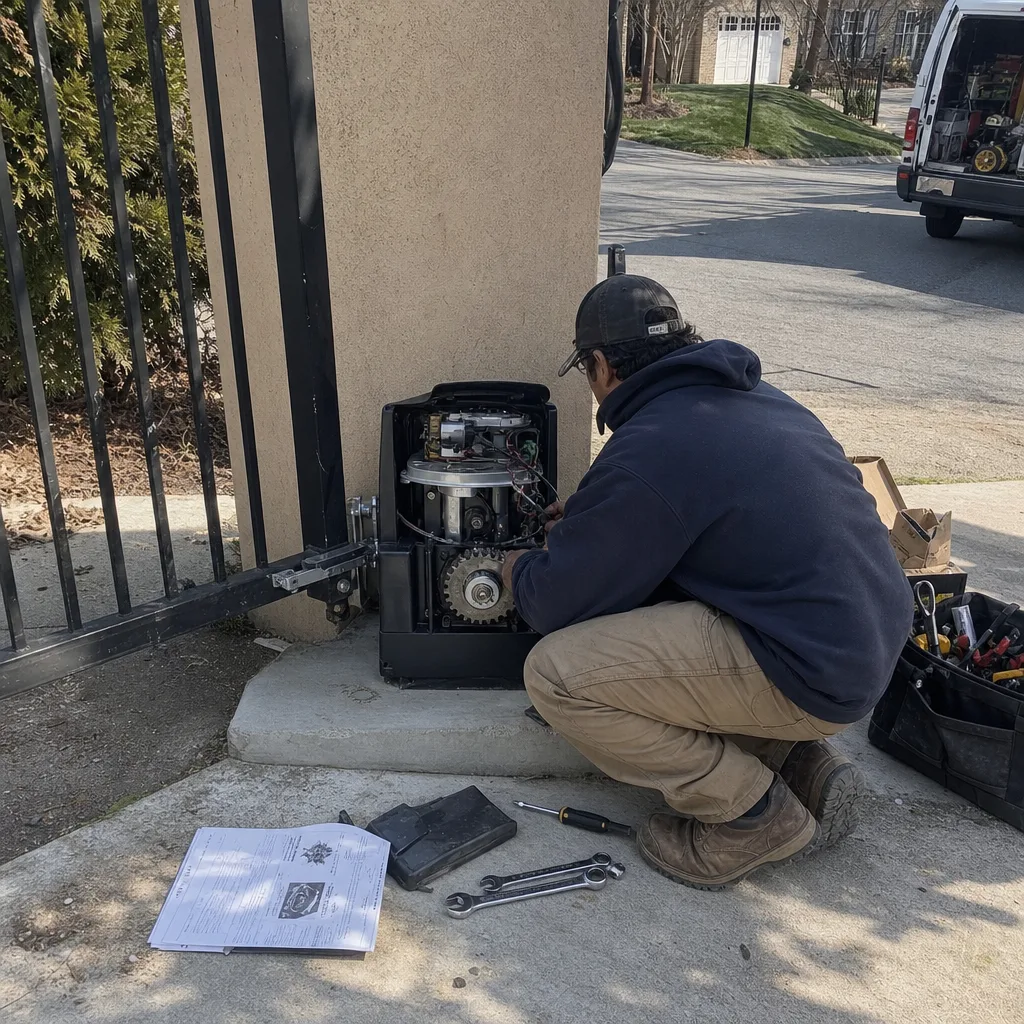
Last updated November 15, 2026
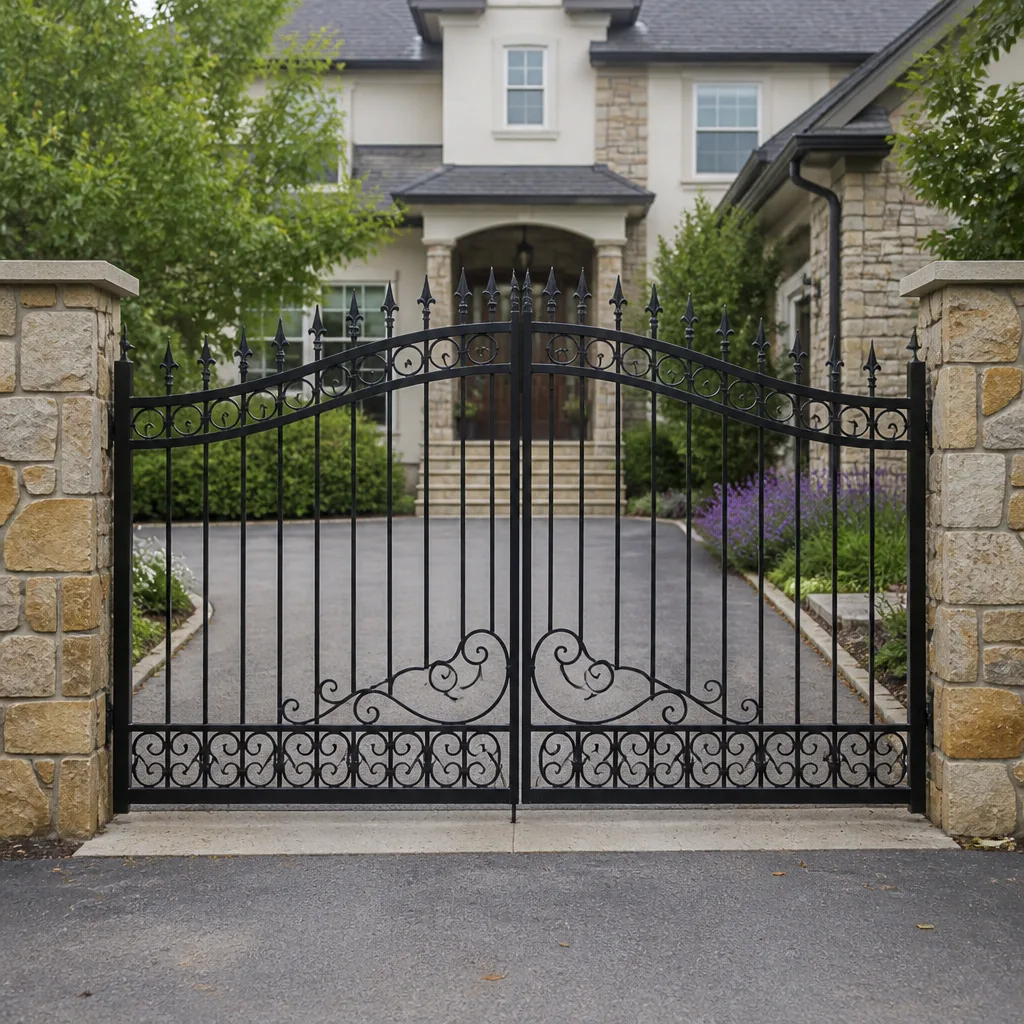 Wrought iron
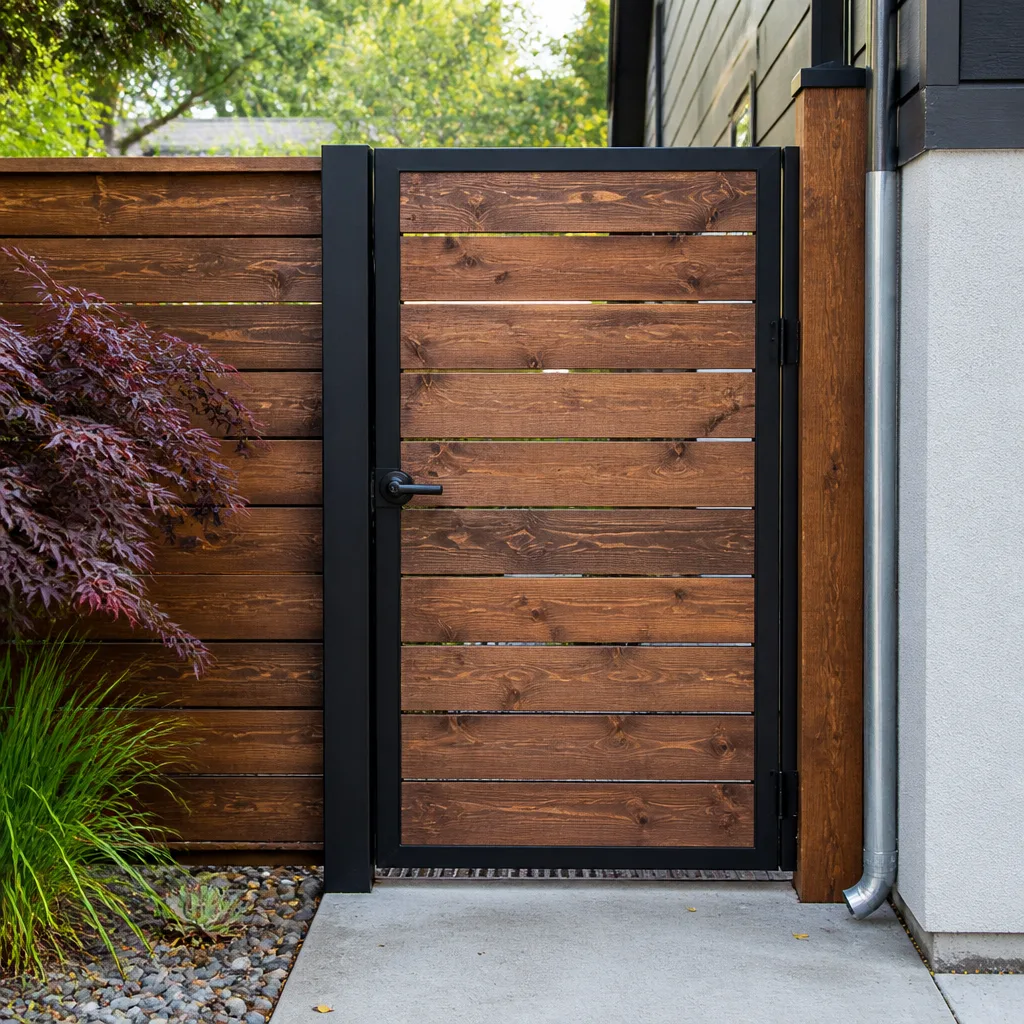 Wood & steel frame
 Farm & ranch
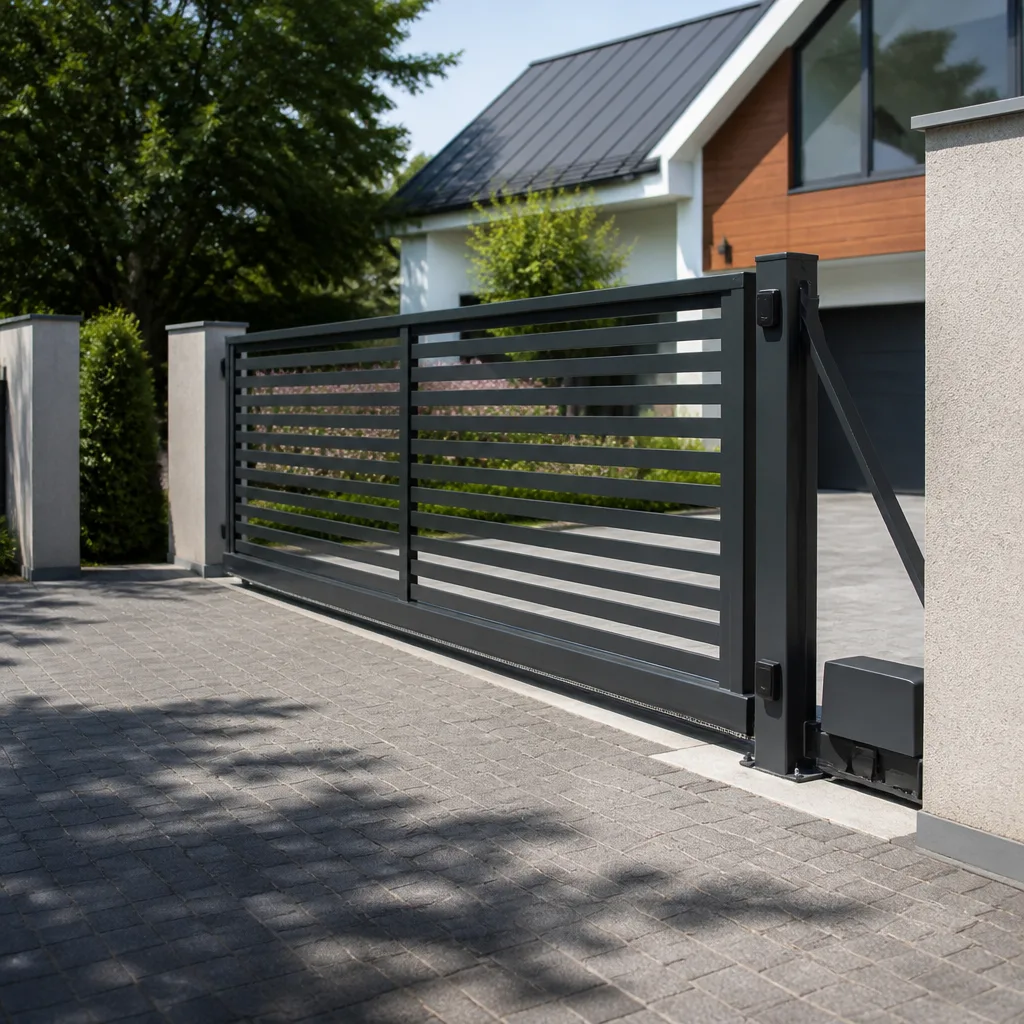 Sliding driveway gates
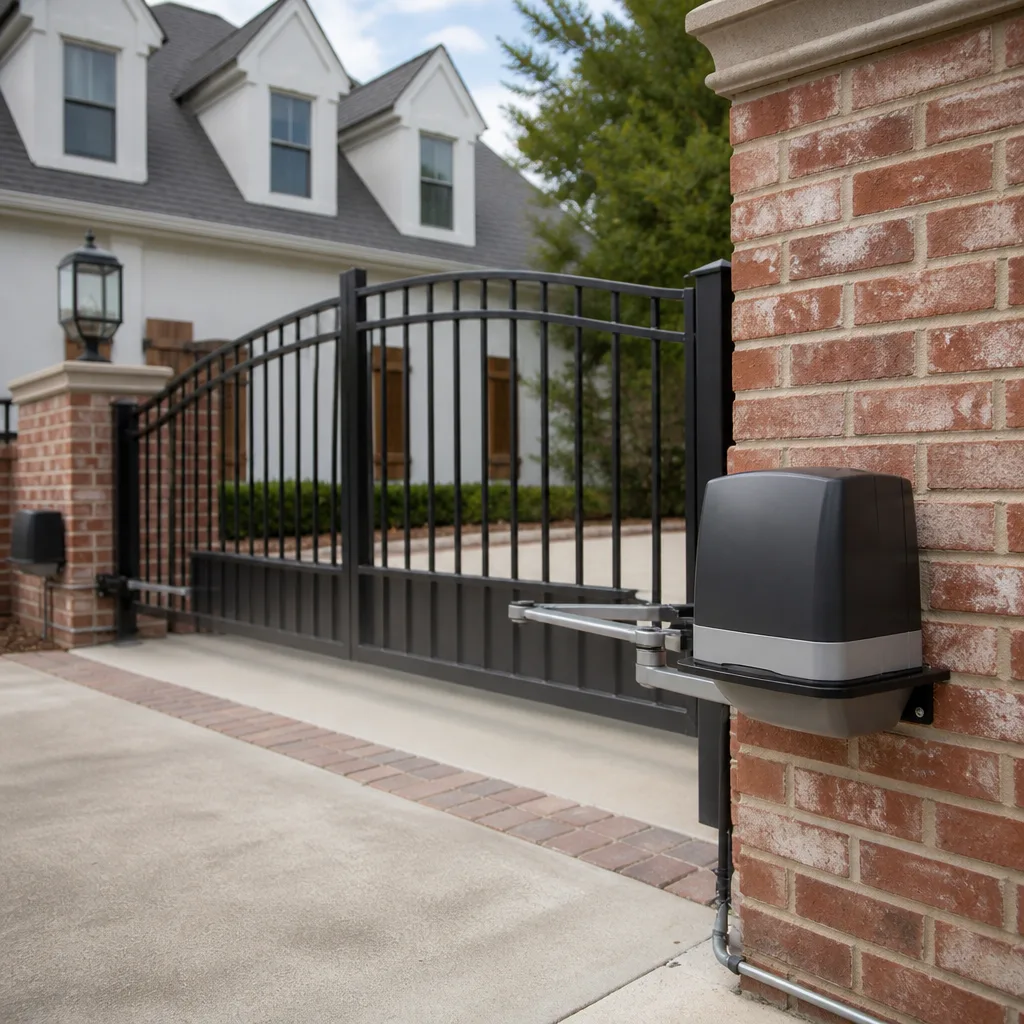 LiftMaster operators
Free on-site gate assessment - hinges, posts, and your LiftMaster or Nice gate operator checked before anything is quoted
The assessment is free and the quote is the invoice.
Get your free estimateGate Repair Warning Signs: An Arlington Homeowner’s Reference Guide
A gate that slows down on a cold morning and a gate that slows down in the afternoon heat can look identical from your driveway, but they’re almost never the same problem. One is usually a lubrication or binding issue. The other often points to an operator straining against heat, a control board losing efficiency, or a battery backup that’s near the end of its life. Get that distinction wrong and you end up paying for parts you didn’t need while the real fault keeps grinding away. This guide maps the symptoms Arlington homeowners describe most often to the failure modes behind them, so you can tell a minor adjustment from a repair that shouldn’t wait. We’ll cover manual and automated gates, what each warning sign means, and how long you can safely sit on it before one component takes others down with it.
Quick Answer
The most common gate repair warning signs are slowing operation, failure to close completely, grinding or screeching noises, remote controls that stop responding, and a gate that reverses mid-travel. In Arlington, each of these points to a fairly short list of causes, and the cause determines whether the fix is an adjustment or a component replacement. Any grinding from the operator housing, a burning smell, or a gate that reverses without an obstruction present should be treated as urgent and checked by a gate technician before the motor or control board is damaged.
Styles & brands we work with
- Wrought iron
- Wood & steel frame
- Farm & ranch
- Sliding driveway gates
- LiftMaster operators
Table of Contents
- The Five Most Common Gate Complaints, Mapped to Their Causes
- Why Is My Gate Suddenly Slow?
- Alignment Problems: Hinge Wear, Post Movement, or Operator Shift?
- Electric Gate Warning Signs Manual Gate Owners Miss
- What Sounds Are Always Emergencies?
- The Escalation Timeline for Each Major Warning Sign
- Manual Gate Problems That Point to Structural Issues
- How Arlington’s Seasons Change What Your Gate Is Telling You
The Five Most Common Gate Complaints, Mapped to Their Causes
Homeowners rarely call us with a diagnosis. They call with a symptom: “it’s slow,” “it won’t shut,” “it screams at me.” The value of a gate-only specialist is turning that symptom into the right cause on the first visit. Here’s the map we work from when a gate in Arlington comes in for gate repair.
- Slow operation. Usually lubrication, track or hinge binding, a failing battery in a DC operator, or a motor working against excess load. Rarely the control board unless other symptoms are present.
- Failure to close fully. Most often a safety sensor or loop detector seeing a phantom obstruction, or a physical obstruction like a settled hinge or a gate sagging out of plumb. Control board faults come third.
- Grinding noise. Chain, sprocket, or gear wear inside the operator, or a roller and track issue on a slide gate. This one rarely resolves on its own.
- Remote dropouts. Dead remote battery, receiver interference, an antenna that’s been knocked out of position, or a control board losing its memory. Each has a different fix.
- Reversing mid-travel. On an automated gate this is almost always a safety device doing its job, or a limit switch that’s drifted. On a manual gate it’s a structural bind.
You’ll notice that the same list of gates, from a residential Ghost Controls swing operator to a commercial DoorKing slide system, produces the same five complaints. The brand changes the parts, not the symptom categories. That’s why diagnosing the actual brand on-site matters more than guessing from a phone description.
Why Is My Gate Suddenly Slow?
A slow gate is usually a gate fighting something, and finding out what it’s fighting is the whole job. Cold-morning sluggishness that clears up by midday is a different animal from a gate that’s slow at 2pm on a mild day. The first is often grease thickening in cooler temperatures or a DC battery operating below its happy range. The second suggests a mechanical bind, a worn motor, or a component drawing more current than it should.
In Arlington, we see a lot of seasonal variation in how this presents. A gate that’s fine in spring can start dragging by mid-summer as wood or metal panels expand slightly in the heat and the operator has to work a little harder against the same clearance. Nothing changed with the motor. The geometry did.
The usual causes we work through, in order:
- Lubrication that’s dried out on hinges, rollers, or the chain
- Track or guide rail with debris, a slight bend, or a worn roller
- A DC operator battery backup that’s aging and can’t deliver the current the motor needs
- A motor that’s lost torque from wear
- Weather-related swelling or expansion in the gate leaf or post
What you shouldn’t do is turn up the speed or force setting on the control board to compensate. That masks the real cause and accelerates wear on the motor and gearbox. If a technician shows up and their first move is to dial up the force, that’s a sign they’re not diagnosing. The right fix is finding what the gate is fighting.
Alignment Problems: Hinge Wear, Post Movement, or Operator Shift?
A dragging or misaligned gate can come from three completely different causes that all look alike from the outside. Getting this distinction wrong is the most expensive mistake on this page, because the repairs range from a modest adjustment to a post replacement.
Hinge wear
Hinges on a swing gate carry the full weight of the leaf, and over years they wear unevenly. The tell is a gate that drags at the latch side, hangs slightly low when open at 90 degrees, and can be lifted a fraction at the free end. Hinge replacement is the fix, and it’s the least expensive of the three.
Post movement
Gate posts settle. Sometimes it’s the soil, sometimes it’s drainage across the property, sometimes it’s just the natural movement of a heavy post holding a heavy leaf for years. A post problem shows up as a gate that’s off-plumb from the frame out, hinges that look fine, and a gate that binds consistently in the same spot no matter the temperature. This is the repair that homeowners dread, and it’s the one that gets misdiagnosed most often as a hinge issue.
Operator mounting shift
On an automated gate, the operator mounts to the post or a concrete pad. If that mount has shifted even a few millimeters, the arm geometry changes and the gate drags through part of its travel. The tell here is that the problem appeared suddenly and the gate runs fine through the first half of its arc, then binds. A manual gate doesn’t have this failure mode, which is worth knowing if you’re deciding whether to automate.
If you’re not sure which of the three you’re looking at, don’t guess with a wrench. A proper electric gate repair visit starts by checking all three before any part gets replaced.
Electric Gate Warning Signs Manual Gate Owners Miss
If you’ve only ever owned a manual gate, you’ve built up a good instinct for mechanical problems: dragging, grinding, sagging. What you won’t recognize are the failure modes that only exist on an automated system. These are the signs that show up months before the gate actually stops working, which is why catching them early saves real money.
- Control board fault codes. Most operators store a fault history. A technician with the right familiarity reads that log and knows what the operator has been logging over the last several cycles. Ignoring persistent fault codes usually ends with a control board replacement that could have been avoided.
- Loop detector false triggers. If your gate starts reversing or refusing to close with no vehicle or person nearby, the in-ground loop detector is often the culprit. It can be a failing loop, moisture in the saw cut, or a detector card losing sensitivity. Brand-specific: DoorKing and Linear systems both use loop detection heavily, and the diagnosis path differs.
- Battery backup failure. Battery-backed operators run their logic through the battery even on mains power. A weak battery shows up as slow operation, missed cycles, or the gate reversing unexpectedly. There’s rarely a light on the housing that says “battery failing,” so this gets missed.
- Phantom remote dropouts. On an automated gate, a remote that works sometimes and not others can mean a receiver issue at the operator itself, not a dead remote battery.
- Safety edge false activations. On a gate with a physical safety edge, a damaged rubber strip or moisture in the contacts will make the gate reverse on a closing cycle with nothing there.
None of these are things you should be poking at with the power on. The control board and the operator’s wiring are high-voltage, and the gate itself can move without warning even when you’ve cut the power at the breakers, if the battery backup is still live.
What Sounds Are Always Emergencies?
Some gate noises are cosmetic. Others are the gate announcing that something is about to fail in a way that takes other components with it. These are the ones we tell homeowners to stop running the gate over:
- A high-pitched screech from the operator housing. That’s usually a bearing or gear failing. Running through it grinds metal into the rest of the gearbox and turns a bearing replacement into a motor or operator replacement.
- A rattle or clunk from inside the operator, every cycle. Chain slack, a failing sprocket, or a worn drive coupling. It will eventually snap under load.
- A grinding that comes from the gate itself, not the operator. Roller, track, or hinge wear that’s developed into metal-on-metal contact. The longer it runs, the more of the track gets ruined.
- A buzzing or humming from the control board that wasn’t there before. Often a relay or capacitor on its way out. Harmless for a while, then suddenly not.
- A groaning under load that’s getting louder. The motor drawing more and more current because the gate is binding. That’s a motor burnout in progress.
Any of these five is a stop-use situation. Don’t run the gate “one more time” to check. The difference between a fix here and a replacement is often measured in days, not weeks. If you’re hearing one of these on a gate in Arlington, call us and we’ll take a look.
The Escalation Timeline for Each Major Warning Sign
Homeowners often ask how long they can wait before a repair goes from reasonable to expensive. The honest answer varies by symptom, so here’s a working timeline based on what we see across the Arlington area.
Can be safely watched for a few weeks
- Intermittent slowness that only appears in certain temperatures
- A single remote that’s slower to respond than others (usually a battery)
- An occasional missed cycle with no other symptoms
Should be looked at within the week
- Consistent slow operation across cycles
- A gate that fails to close about once a day or more
- One phantom reversal per week or so
- A control board reading a recurring fault code
Stop using the gate now
- Any of the five emergency sounds above
- Reversals on every closing cycle
- A gate that’s visibly out of alignment or binding hard
- A burning smell from the operator or control board
- The gate moving without command, or refusing to stay put when opened
The pattern behind the timeline is cascade risk. A slow gate rarely breaks anything else. A grinding operator can take out the gearbox, the motor, and the control board in quick succession. A binding gate strains the operator mounting, the hinges, and eventually the post. The question isn’t “how bad is it now,” it’s “what else is it taking with it.” That’s why the answer is almost always to get Arlington Gate Service eyes on it faster for mechanical symptoms than electrical ones.
Manual Gate Problems That Point to Structural Issues
A manual gate that starts to misbehave is telling you something different from an automated one. There’s no operator to blame, so the message is almost always about the gate itself: hinges, posts, latch hardware, panel integrity, or the concrete that holds the posts in place. These are the signs that mean “have this looked at before the structural problem gets worse.”
- The gate no longer swings or slides freely by hand. That’s a binding issue. On a swing gate it’s usually hinge wear. On a slide gate it’s usually the guide track or the rollers.
- A visible gap or overlap at the latch side. The gate is out of plumb, which points to hinge or post movement.
- Wobbling at the free end when you push it. Hinge or post issue, and worse when the gate is at a different angle than usual.
- Panels that no longer line up flush. On a wood or metal gate this can be panel settling in the frame, hinge wear, or post movement. A technician who knows to check the post first will save you the panel repair cost.
- A dragging section that changes with the seasons. Wood panels expand. Metal panels don’t, so on a metal gate this is almost always alignment.
Structural problems are slow. You can usually wait a few weeks. What you don’t want to do is ignore them for a season, because a post that’s begun to lean will keep leaning and the fix gets more expensive each month.
How Arlington’s Seasons Change What Your Gate Is Telling You
The same gate can behave differently across the year here, and part of knowing what’s a warning sign versus a quirk is knowing what to expect in your local climate. In Arlington, the pattern runs roughly like this:
- Cold snaps in winter thicken grease and lower the output of any battery-backed operator. Slow-morning operation in cold weather isn’t automatically a problem.
- A battery that’s aged tends to show its weakness first on the coldest mornings, before it fails in milder conditions. A single sluggish morning in January is often a warning sign for the battery.
- Summer heat expands wood and can slightly shift the fit of a wood gate in its frame. A gate that drags a bit in July but not in March is usually geometry, not the operator.
- Rain and humidity push moisture into wood, safety edges, and any exterior switches. Electrical faults that appear only after rain are usually moisture-related.
- Freeze-thaw cycles move the ground under posts. That’s where a lot of slow alignment drift comes from, and it’s why an Arlington gate can go out of plumb without any impact or accident behind it.
None of this is cause for alarm on its own. What it means is that gate maintenance and diagnosis in Arlington have to account for the season: a technician who shows up in July and doesn’t think about what the same gate was doing in January may not catch a battery that’s on its way out.
Common Mistakes to Avoid
- Turning up the force setting to “fix” a slow gate. That masks the real bind and accelerates motor and gearbox wear. The fix is finding what the gate is fighting, not pushing harder.
- Treating a misaligned gate as a hinge problem. Hinge wear, post movement, and operator mounting shift look similar but require completely different repairs. A technician who goes straight to hinges without checking the post and the mount will often fix the wrong thing.
- Replacing a remote before checking the receiver. On an automated gate, an intermittent remote can mean the receiver or antenna is the problem. A new remote without a receiver check rarely solves the issue.
- Waiting on a grinding sound. Grinding from an operator or a track turns a modest repair into an operator replacement more often than any other symptom. Stop using the gate and get it looked at.
- Ignoring fault codes on the control board. A recurring fault code isn’t a suggestion. Linear and Viking boards in particular will tell you what they’re struggling with; ignoring the record leads to a board replacement that could have been avoided.
- Washing down an automated gate without thinking about the safety edges. Moisture in a safety edge contact strip causes phantom reversals that then get misdiagnosed as a loop detector problem.
- Ignoring a gate that swings harder after heavy rain or a hard freeze. Post movement develops silently. A gate that’s hard to move by hand is telling you the ground under it has shifted, and that’s a fix that’s cheaper now than later.
See the difference
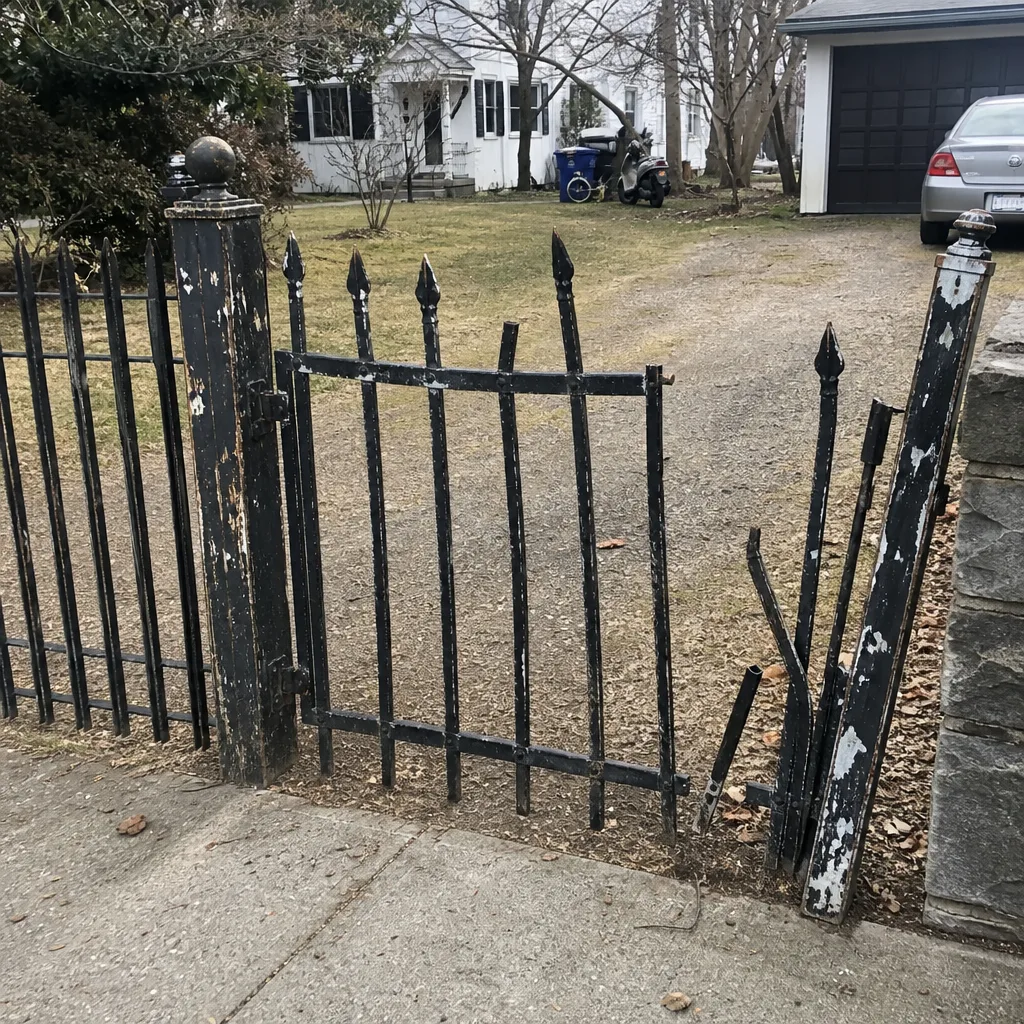 Before
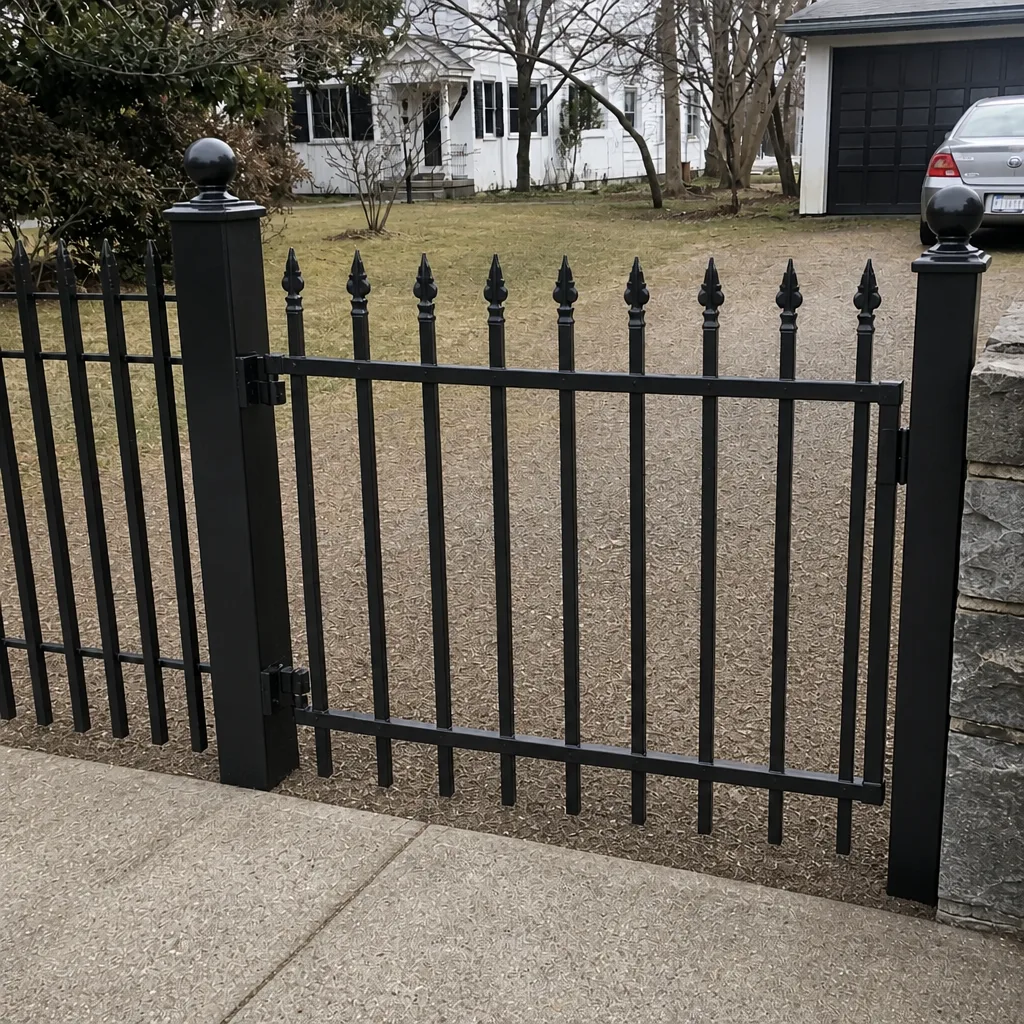 After
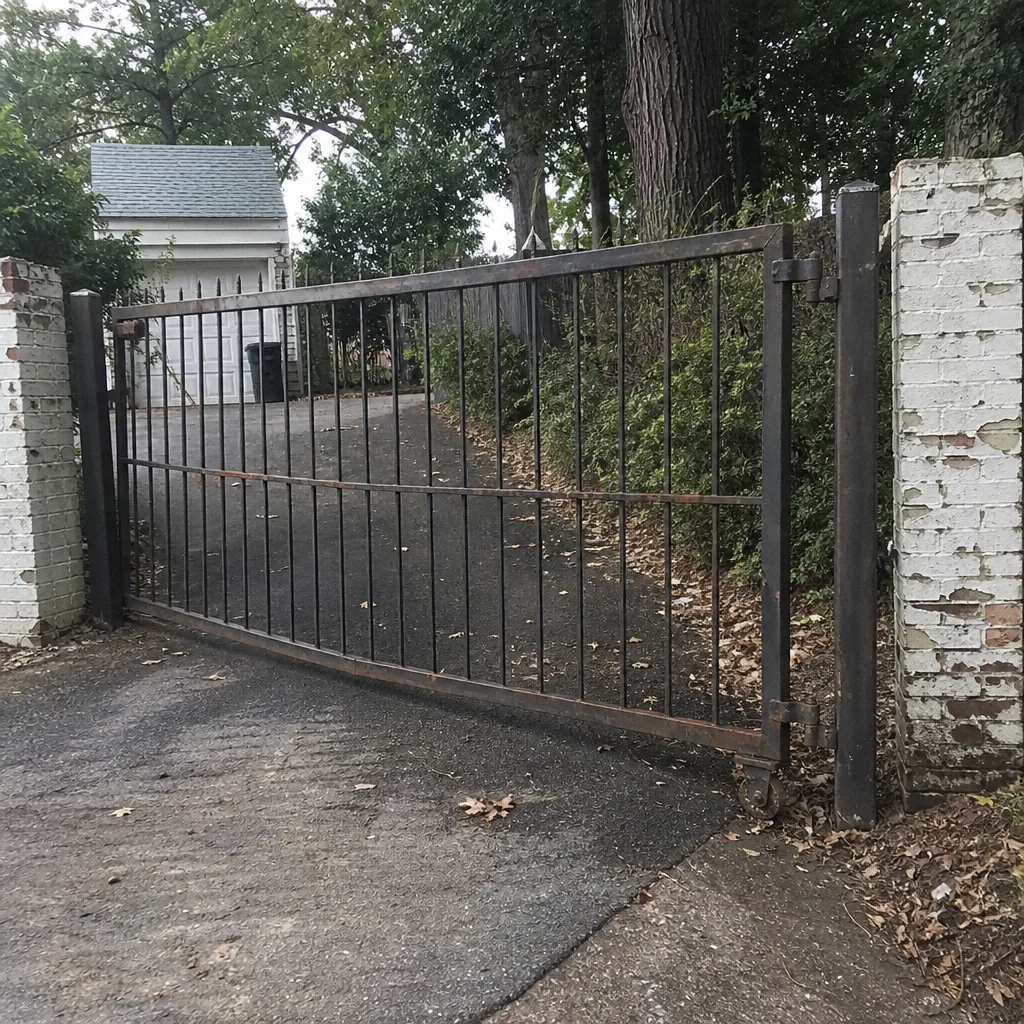 Before
 After
 Before
 After
When to Call a Professional
You should call for any grinding, screeching, burning smell, or gate that moves without command. You should also call if the gate has stopped closing reliably, reverses repeatedly with nothing in its path, or has visible alignment problems you can’t pin to a hinge. And you should call if you’ve already had someone out and the gate still isn’t right, because a misdiagnosis repeated twice is more expensive than a proper diagnosis the first time.
The one thing we’d ask you not to do is diagnose a control board or operator fault without a technician. The wiring carries significant voltage, and a live safety edge on a gate that can still cycle under battery backup is a real hazard even after the breakers are off. Our technicians have up to 10 years of experience, we work on nine major gate operator brands from residential-grade Ghost Controls to commercial DoorKing systems, and we’re a gate-only shop, which means the person who shows up has seen your problem before.
Arlington Gate Service offers free estimates in Arlington. Call (855) 349-3550 to get it diagnosed right the first time. We answer 24/7. Fast dispatch from 7am to 7pm, Sunday through Friday.
Frequently Asked Questions
The earliest reliable sign is slowing operation, followed by a change in the running sound and a remote that’s become intermittent. Any of these three showing up together on the same gate is a strong signal to have it looked at. Call (855) 349-3550 for a free estimate.
If it’s only slow on cold mornings and runs fine otherwise, it usually can wait a few weeks. If it’s slow every cycle or getting progressively slower, don’t wait: the operator is working harder than it should and the fix gets more expensive. Call (855) 349-3550 for a free estimate.
Hinge wear shows up as a low-hanging free end and dragging near the latch, while post movement shows up as consistent binding in the same spot regardless of temperature. If you can’t tell them apart, a technician can, and the diagnosis matters because the repair differs. Call (855) 349-3550 for a free estimate.
No, but it’s worth diagnosing because intermittent remotes are often a receiver or antenna issue at the operator rather than a dead battery in the remote. Replacing the remote first usually wastes money. Call (855) 349-3550 for a free estimate.
Repeated reopening with nothing in the path almost always means a safety device is firing incorrectly: a loop detector, a safety edge, or a limit switch that’s drifted. That’s a stop-and-call symptom since the gate can’t be trusted to stay closed. Call (855) 349-3550 for a free estimate.
We work on nine major gate operator brands, including LiftMaster, Linear, Viking, DoorKing, FAAC, BFT, Ghost Controls, Elite, and Mighty Mule. Our technicians diagnose the actual brand on-site rather than applying a generic fix. Call (855) 349-3550 for a free estimate.
The Bottom Line
The most expensive gate repairs are the ones that could have been avoided by knowing which symptoms are a quirk and which are a warning. Slow operation that only appears in cold weather is usually benign; grinding, screeching, burning smells, and repeated phantom reversals are not. Alignment problems have three distinct causes (hinge wear, post movement, operator mounting shift) and getting the cause right saves the difference between an adjustment and a post replacement. Electric gate owners should watch for fault codes, loop detector false triggers, and battery backup weakness before the gate stops entirely. And when something is clearly wrong, getting a gate specialist out once is almost always cheaper than guessing twice.
Call Arlington Gate Service at (855) 349-3550 for a free estimate. We answer 24/7. Fast dispatch from 7am to 7pm, Sunday through Friday.
Written by the team at Arlington Gate Service.